


FOUR ON THE KITCHEN FLOOR
…as if someone held a filter to my ears, and all there was left from that love-hate relationship was the love
-Manal Aziz
The story of the becoming of Minuit Treize – the latest release on raghoul by Tunisian producer Metttani and Japanese experimental electronic musician Kopy. Born on the kitchen floor of a Tokyo apartment, the four-track EP found its way to Casablanca to be shared with the rest of the world in May of 2026.
Sometimes we find gems. Sometimes gems find us. I’m not gonna lie, (cause who has time for that in this economy?), whoever knows me knows I have a love-hate relationship with four-on-the-floor. Love cause I respect the journey, and it’s what shaped my formative adult years in electronic music and club culture. Hate, because much like with many other things in life, the repetitiveness and predictability tend to bore me sooner or later. But with you, dear readers, as my witnesses, I stand corrected.
I stand corrected as Minuit Treize turns out to be the exception that proves the rule. The way Gambaru Gambaru reeled me in and held me down… I was already considering what tracks to mix it with on my first listen, trying to dissect its different layers. I tried so hard figuring out which part was made by whom, but I still failed. Honestly, the word seamless is used so often when writing about music that its power has been diluted by now, but I dare anyone who listens to the EP to tell me where Metttani ends, and Kopy begins or vice versa. I’ll be waiting patiently.
Because when there’s chemistry, you feel it. And part of what made me so excited about Minuit Treize is that it’s drenched in it. The story of its becoming is one of cultural transcendence, music as a universal language and the power of the present. The day we got off that first video call, I started drafting my questions about the release, which would later become this story of its becoming.
We casually plugged our gears on the kitchen floor, and the energy flowed immediately…
-Metttani
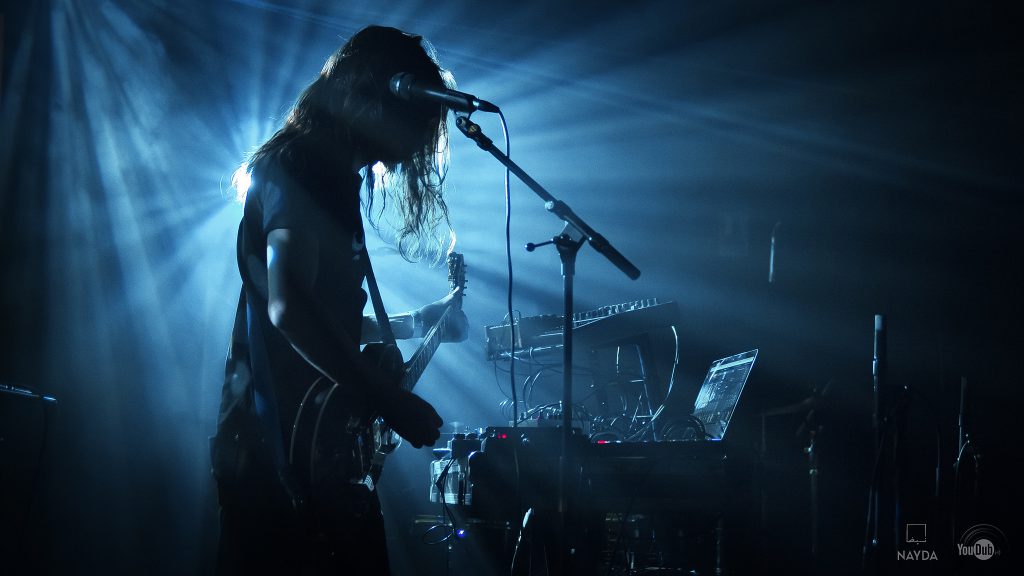
It all started with a hangout-turned-late-night jam session on Yuko Kureyama, aka Kopy’s kitchen floor. ‘We played the same event in Harajuku and immediately connected through the groove’, Kopy says. The Japanese experimental electronic artist shared the same lineup with Metttani, who was visiting Tokyo and happened to play the same venue called Bonobo – a tiny club with an amazing vintage sound system. ‘I was immediately amazed by her radical approach to live improvisation,’ Metttani recalls. ‘It reminded me of my early live sets.’
Metttani is one of the aliases under which the Tunisian Shouka label and Arabstazy collective founder produces music. His approach to electronic music is infused with the essence of acoustic sounds and live performances, much like the works of Kopy, who relies heavily on live aspects of their music.
The two met in the evening at Kopy’s place after she returned from a trip to her hometown, Osaka. With limited means of communication (Metttani struggling with Japanese and Kopy with English), their mutual friend Emi, who connected them, was helping out with translation. ‘We casually plugged our gears on the kitchen floor, and the energy flowed immediately. She would start with beats and effects, and I would tag along with lead and bass melodies,’ Metttani says.
Curious about how two seemingly separate universes can merge so coherently, I ask Metttani and Kopy about their respective approaches to music. Metttani responds: ‘Most of the time, my tracks originate from improvisations. I refine them through an iterative process of performing live until they reach a more or less final arrangement. That’s why jamming and improvising were the most straightforward way to interact.’ ‘Musically, we weren’t that different,’ Kopy concludes.
Both artists also mention an alliance between the known and the unknown. Kopy: ‘I feel like this project sits in a place that’s both new and somehow familiar at the same time.’ Something I relate to while listening to it over and over again. A kick taking me back to 2011, a synth reminding me of a high I thought I’d never come down from a decade ago, and a back and forth that reminds me of those incohesive conversations at the break of dawn. As if someone held a filter to my ears, and all there was left from that love-hate relationship was the love.
‘The final result, in my opinion, sounds like neither of us would compose on our own,’ Metttani elaborates, ‘For instance, I almost never compose four-on-the-floor drum patterns, but this time it felt like the obvious way.’ He continues to explain how he normally has acoustic instruments at hand, which weren’t available to him at the time, being so far away from home. ‘I believe this contributed to the distinctive synthetic and cold feel of the tracks.’
The electronic music scene in Japan is still not very popular. However, there are many talented musicians!
Eager to learn more, I ask them to take me a bit further into their approach, inspirations and sounds. ‘I felt like we artistically connected through a non-figurative approach, the harsh and noisy aesthetics.’ This coincided with Amine’s first impressions of Tokyo. ‘It’s a city where loneliness can hit you hard while you drown in the multitude.’ They were both quite exhausted that night, which might’ve contributed to the rough, emergency feel of the record. ‘I get very urban, dystopian vibes from these four tracks, and I think that fits the way humans get swallowed by huge cities that never sleep, and having to work several jobs.’
Although by no means comparable in absolute numbers and density, I draw a parallel with Casablanca. In this broken white city, lauded and despised for its grind, music used to be (and I like to believe still is and can be) a means to congregate, a kind of glue that connects and holds together, one that forgives and helps forget the harshness of everyday life. More needed than ever, I can’t help but wonder sometimes what the musical landscape would’ve evolved into if COVID hadn’t hit when it did, taking with it tens of thousands of lives, including a nightlife that was only just coming of age.
Curious about the parallels between Japanese and Tunisian electronic music culture, Kopy, who herself is part of the Japanese underground scene, keeps it short: ‘The electronic music scene in Japan is still not very popular. However, there are many talented musicians!’ We don’t dive much further into why that’s the case, and I’m left wondering if it’s a matter of infrastructure and venues, like here, or if there are other dynamics at play. All I know is that the impact of culture at large on the way we experience music should never be underestimated.

As for Metttani, who has been running a label of his own, called Shouka, for quite some time now, he reminisces about the days of Music Techno Studio 2000, double cassette players and 4-track Tascam recorders. Growing up in a time when, in Tunisia, a teen couldn’t get his hands on electronic music hardware, Metttani imagines it might’ve been easier in Japan – homeland of Yamaha, Roland, Korg and Akai. However, technology in a globalised world and independent music scenes have made it possible to connect through platforms such as MySpace (for the youngsters, that’s the social medium of our age).
‘The way I might experience a[n other] difference, as an observer, is that the relationship to rhythm is very different in my home country.’ In Metttani’s experience, Japanese audiences approach electronic music from a more intellectualised perspective, whereas Tunisian audiences are more focused on how the bass glues everything together. ‘Of course, you’ll find outliers on both sides,’ he adds. ‘Sometimes I like to think that Japanese and Tunisian mentalities are so diametrically opposed that mixing them would result in a perfectly balanced product.’ Minuit Treize might be a testimony to that.
The release is different from what we’re used to releasing on the label, and it makes me extra excited to share it with our listeners. There is something equally mesmerising and disturbing about each track – rhythmic as in I could powerclean my house to this and dynamic as in I could listen to this being played in a dark basement and not get bored, no questions asked.
…I believe that human emotion is the only thing we can truly offer.
Actually, the whole EP sounds like it was made by one person, and that’s one of my favourite parts about collaborations: when the line between one artist and the other kind of fades away, and a different, third thing is born. Those moments leave traces, and I wanted to know how this specific collaboration impacted the way Metttani and Kopy make music or relate to sound now.
Metttani: ‘It opened my mind about the fact that I can actually make and listen to four-on-the-floor tracks without getting bored! Kure-chan’s way of improvising paved the way for my ears to be able to enjoy the subtleties that can happen when the frame is so square and predictable.’
Kopy: ‘I believe every release has some kind of impact on the person who created it. I recorded at home in the same way I usually perform live. The other parts were layered on top later on. By expanding the musical world through that moment of concentration and then layering both of our sounds together, it grew even further.’
As I’m writing this, so much is going through my mind. It feels like for the past few years, much has been changing, musical landscape included. I’m thinking politically – several genocides, World War III and drastic climate impact -, but also practically with AI music taking up space on streaming platforms, venues disappearing worldwide, and shortening attention spans and saturated ‘markets’, making artists have to work extra hard – if not beg – to remain relevant.
We love and value transparency into what it means to be an artist and to make what you want to make. I do believe that if we were more transparent and honest as an industry (do those words even mix well?), we’d solve most of the issues we face, such as fair pay, abuse, intellectual property theft, etc. As an artist, what could you tell our readers about navigating change, authenticity and the way our environments and the times we live in affect our practices?
For Kopy, there is only one thing we can truly offer… ‘AI is amazing, but I believe that human emotion is the only thing we can truly offer. So I try to follow and value my feelings and emotions.’
Metttani copes with it the same way everyone does… or doesn’t. ‘I have never thought of my music or anything I do as particularly important. I don’t expect anything from it. Making music has always been part of my life as long as I can remember, and it’s a vital thing for me.’ Metttani elaborates, ‘Since I am not a very talkative person, I don’t open up easily and tend to keep to myself; music allows me to express feelings I go through but cannot narrow down. It is such a necessary outlet; without it, I would dissolve from the inside. This is not something that will change because of AI, war or capitalism.’
As for Minuit Treize, both Kopy and Metttani believe that what is to be taken away from the EP belongs to you, the listeners.
Editor’s note:
Shouka label owner, Amine Metani, is releasing his upcoming album “Limerence Limbo” on Inner Demons Records under the moniker Mostafa Kölz, the alias under which he releases his beatless productions ranging from melodic ambient to harsh noise. For more work by Metttani check his previous album Tawātem. For more of Kopy, check out this raghoul favourite: Heart Fresh.
This article was written by a human and may contain mistakes. I don’t mind being corrected!
Words by Manal Aziz


